


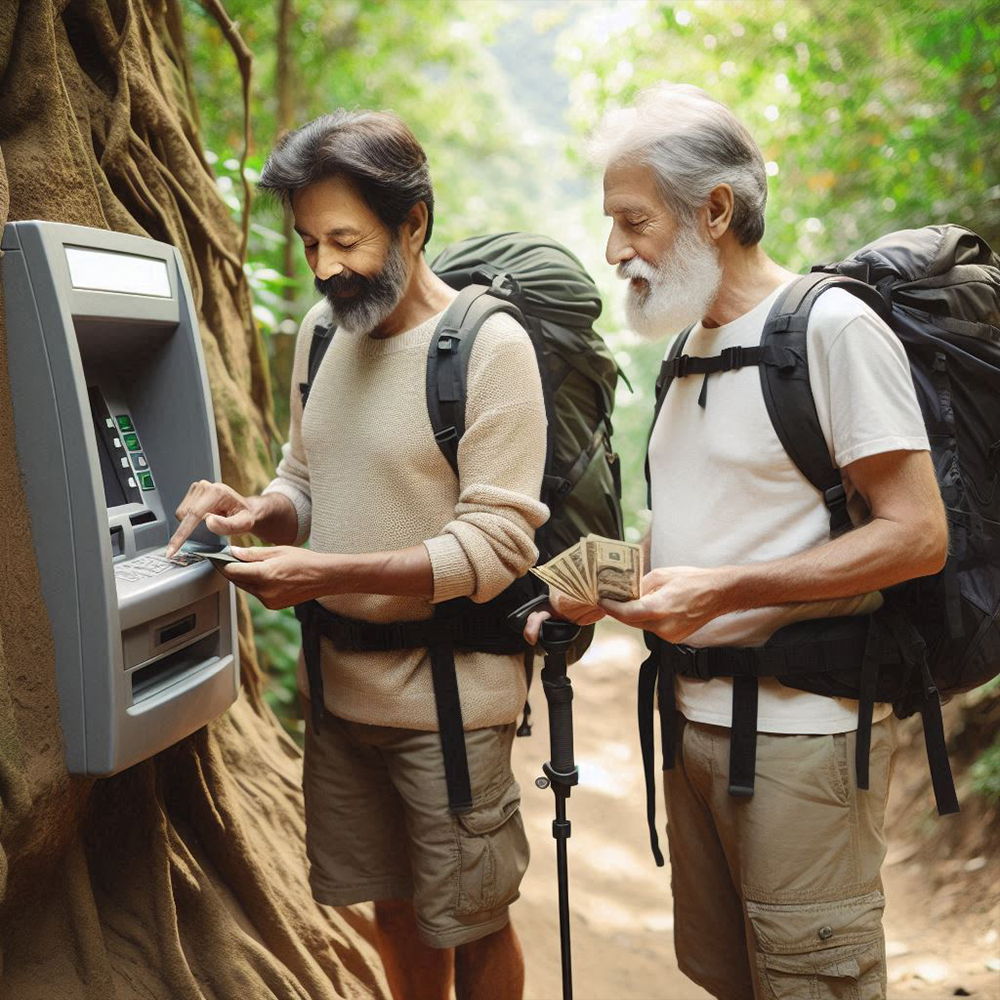
CASH WITHDRAWAL AT AN ATM ABROAD
To withdraw cash from an ATM abroad, you must have an international card.
This is the case if it bears the Visa or Eurocard / MasterCard logo.
If you have any doubts, it is best to check this with your bank branch before you leave, to avoid finding yourself without cash during your trip. Of course, when you use your card abroad, the machine dispenses banknotes in the local currency.
ATMs you encounter abroad may not necessarily accept your card. In principle, the accepted card types are displayed next to the machine. Therefore, if you have a Visa card, check that the machine is affiliated with this network. The same applies if you have an Eurocard / MasterCard.
Be aware of the authorized limit abroad: Inform your banker before you leave to prevent your card from being blocked due to suspected fraud, and take the opportunity to negotiate bank fees, insurance, and withdrawal limits.
COST OF A WITHDRAWAL ABROAD
As you prepare for your upcoming trip abroad, you, like many others, may think that ATM withdrawals will incur various high fees.
EUROZONE (1)
If you are in the Eurozone, these banknotes are exactly the same as those you could withdraw in France. Furthermore, since July 1, 2002, European legislation requires that the pricing conditions applied to a euro withdrawal made in another country be the same as if the withdrawal were made in France.
OUTSIDE THE EUROZONE
If you withdraw money outside the Eurozone, the withdrawal in local currency will necessarily appear on your account statement as a currency exchange operation, the cost of which is integrated into the exchange rate. In this case, the operation also incurs a commission (around 5 to 8 euros for a 150 euro withdrawal) unless there are reciprocity agreements between banks that allow for a reduced rate.
(1) As of January 1, 2015, the Eurozone comprises the 19 countries that have adopted the euro as their single currency: Austria, Belgium, Cyprus, Estonia, Finland, France, Germany, Greece, Ireland, Italy, Latvia, Lithuania, Luxembourg, Malta, Netherlands, Portugal, Slovakia, Slovenia, Spain. The European Union (EU), on the other hand, includes 28 members, which is 9 more countries than the Eurozone: Bulgaria, Croatia, Czech Republic, Denmark, Hungary, Poland, Romania, Sweden, United Kingdom.
Regardless, whether one is in the European Union or not, withdrawing national currency from an ATM incurs exchange fees. The conversion of the withdrawn amount from foreign currency to its euro equivalent is handled by the Mastercard or Visa International Center (depending on the card), according to the exchange conditions of each banking network. “In countries not belonging to the European Union, your withdrawal, again, results in a currency exchange operation, and legislation, in this case, does not prohibit banks from passing on their specific processing costs,” explains the FBF on its public website.
Always compare ATM withdrawal fees abroad, outside the Eurozone.
It should be noted that these withdrawal fees may be included in the annual fees of very high-end credit cards. Different rates may also be applied by certain banks and in specific geographical areas. This is particularly the case in Switzerland for some institutions operating in border regions or in international banks for withdrawals at ATMs of a subsidiary or partner bank.
Withdrawing Money at the Airport
Airport exchange offices often display different rates but have the advantage of immediate cash availability. This is often very convenient when abroad, especially if you haven’t had time to exchange your currency before departing. In any case, it is important to know that you can exchange your money at airports, in some train stations almost 24 hours a day, and in most hotels, but exchange rates are very high, particularly where there is no competition.
The advantage is that you immediately have local currency.
Tip: Exchange a maximum of 100 euros to cover initial expenses. It is often more advantageous to exchange currency in the city, as competition allows for better rates.
RETURNING FOREIGN CURRENCY TO FRANCE
It is worth noting that some banks will not exchange your foreign currency back into euros upon your return to France.
If you decide to exchange your money with your bank, remember to notify them 48 hours in advance and inquire if they accept the currency.
Tip: There are also websites like Weeleo that allow individuals to exchange currencies: http://www.weeleo.com/fr/
CONCLUSION
– Inquire with your bank.
– Estimate your needs to accurately plan a ‘cash’ budget.
– To minimize fees: group your cash withdrawals. Due to the fixed portion of withdrawal commissions charged by banks, you can reduce these costs by making larger withdrawals. However, this is subject to the maximum limits set by certain establishments.
– Whenever possible, card payments abroad are preferable, as the fees charged are generally less expensive. Indeed, while the variable portion of this commission is often identical to that of a withdrawal, the fixed amount is usually lower or non-existent.